
First impressions in the Substack ecosystem
We’re taking a look at bestseller Rachel Katz's newsletter and how to think expansively about your own first impressions online

In today’s conversation, Erin Shetron joins me again to talk about some of the particulars around bringing your writing into the world. This is the first of two explorations I’ll be hosting this week around first impressions. In our discussion, Erin and I dive into how readers subconsciously take in information about you and your writing, and we look specifically at a few places in the Substack ecosystem, including:
(04:04) Substack Notes (which includes your photo, personal bio and publication’s “short description”);
(9:00) Welcome Pages; and
(18:41) Home Pages.


As a companion piece to this conversation, Amanda published a resource that you can use to consider your own first impressions. It’s a sequencing exercise she uses with clients (and on her own newsletter) when pageviews on a newsletter are going up, but newsletter sign-ups are not.


Transcript for today’s conversation
Amanda Hinton: Well, hello there, Ms. Erin. How are you today?
Erin Shetron: I'm so good! I'm excited to talk with you and nervous to record it because that feels so different than a normal conversation somehow.
Amanda: I know it is different because, well, these conversations are usually done in our pajamas. But thanks for being here and for anybody watching, we were chatting a couple weeks ago about first impressions. And you said, let's just have a conversation about how you make a first impression online. I think it's something that matters to a lot of people, whether they know it or not. It matters to readers, for sure, like how they perceive you as a writer and what you're bringing into the world.
I feel like right now there are different sections of the world where the general sentiment is, "I don't want to be perceived at all online. Don't make me be perceived. It doesn't feel good." And I think that's probably a good undercurrent there, right? That's a good thing. We want to belong to ourselves and not worry about how other people see us. But if I was to reframe that positively, I would say that if you're a writer trying to find readers that there is some element of laying out a welcome mat for readers; how you invite them into the work that you're doing in your life; and through your writing and through whatever sort of community you're cultivating.
And so today we're going to talk about just a few of the elements of a first impression inside Substack's ecosystem. It'd be lovely if we just had the data and we knew that a reader looks here, looks here and looks here. That'd be lovely.
Erin: Substack share your heat maps!
Amanda: Yeah, share your heat maps. That's right. But since we don't have those, we have to use some empathy exercises, and put ourselves into the minds of readers. And that's what we're hoping to do today is help folks think through what those things are.
Erin: Yeah, absolutely. So this conversation, I think will be probably most helpful for a few groups of people. One, if you're just starting out on Substack and you're thinking about the first impression that you want to make to new readers for the first time, this will be, I think, really helpful. Also, if you are prepping for an influx of some new traffic, maybe you're going to getting published soon in an online literary magazine [or in another Substack]. And just in general, anyone who wants to tighten up and clarify their mission and bring some cohesion to their newsletter, I think this is also a good starting point… some things to consider.
Amanda: And when we were talking about, we asked ourselves, “How do we narrow this down?” Because you can make a first impression in a lot of places online and that can just become, well, for me anyways, it became way too overwhelming. And then I just peaced out and went, “I don't wanna think about it.” I think for the sake of this being fruitful for people, we are gonna talk a little bit about how new readers might find you in Substack. And the centralized place for that is Notes, right?
Erin: Yeah, it's becoming the way. Right, through Substack's updates, new people, if you get shout outs from your readers, if you get shared, they're gonna find you probably via a Note.
What is a reader’s first impression when they find you on Substack Notes?
04:04
Amanda: Yeah, so what are they seeing when they find you through a note, a piece of writing or a note? And what's that first impression like? So the first place that they're gonna see, sadly, I wish it was the words, the words are what sweeps them away. But I learned years ago when I was writing coffee table books that most people are looking at the pictures. They just are. That's where our eyes go first. And in every medium, we go into the thing that's most immersive and that is the photo.
So what is your avatar? Is it your logo? Is it your face? Erin and I had a lot of fun going around about me putting my full face in my avatar. Because I just, it's been, you know, as a child of Facebook (I was at one of the first colleges to get on there) [here’s a whole thing at play here around] the progress of being known online. [At some point] I was like, I'm done being known! I don't want anybody to know me online. I just want to be myself. And oh sorry ... my candle just blew out. If you see some smoke, my house is not on fire, guys. Not to worry.
Erin: I love that you had a candle burning for us.
Amanda: I did. You're welcome. You're welcome. You're all blessed now. But yeah, so what what sort of impression do you make in your photo? Are you ... does it make sense? I love creative avatars. I think it's awesome when someone tries to reinvent what an avatar could be. But does it make the impression that flows in a way that makes sense to the next places the reader is going to see you.
Erin: Yeah, I think we're talking right now about, you know, when people find you on Notes, and they click on your name, or they hover over your name if they're on desktop, they do see that personal bio before they see the newsletter branding that you've got going on. So if you are someone who's really—like you're prepping to write a book, you know, you want to have your face attached to your work. Then yeah, I would suggest like having a personal bio that is a photo of you and maybe you're looking to camera. And that's probably the best first impression for you as someone who's the face of your newsletter. But if that isn't your bag, and you want a little anonymity, then I know people who do just fine and they don't have a personal headshot at all, they just use something entirely different. But yeah, if you think about what your goals are, I think that will help you decide what kind of image you want to use for your personal bio.
See “hover” info for E. Jean Carroll:
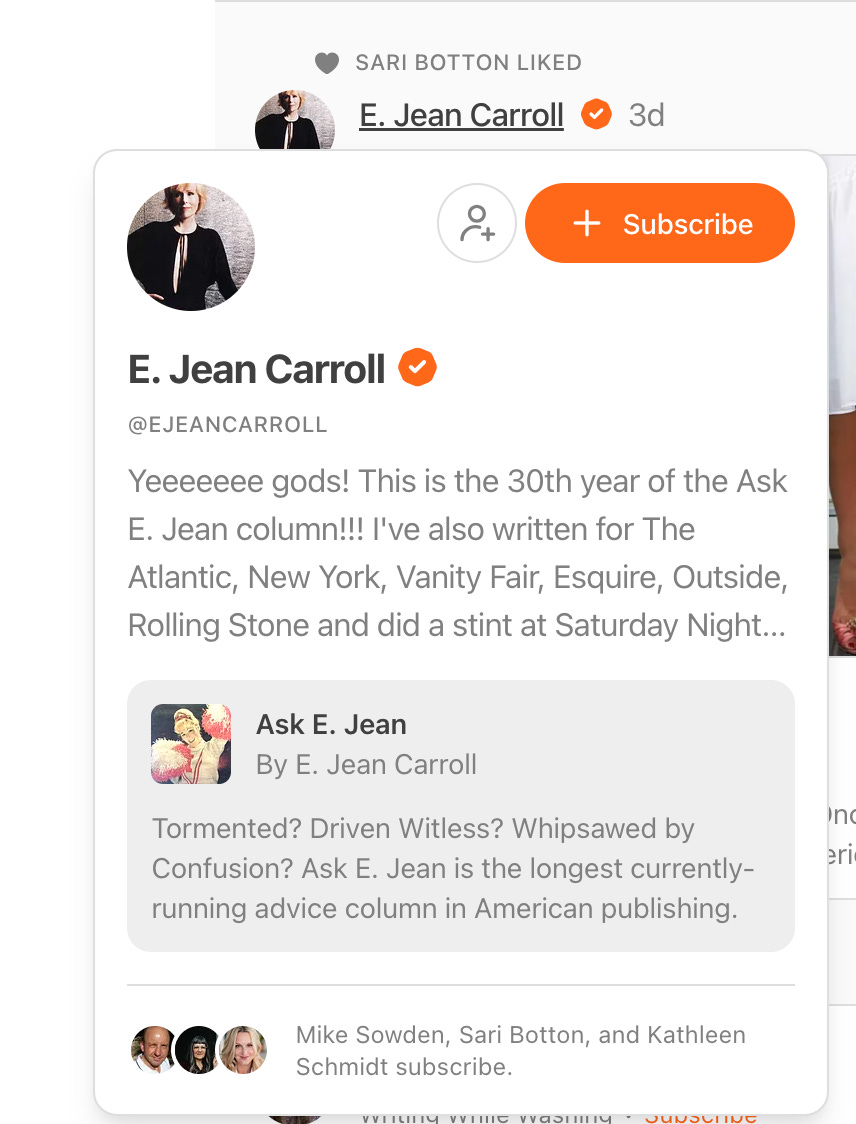
Amanda: And so in that little capture, if someone hovers over your name on Notes, they've seen your face, and then the hover is your personal bio and then your publication description. And these are two that you could tweak for the rest of your life … you probably will be tweaking them for the rest of your life. And if I had to say that there are any like best practices here, I try not to repeat what one says in the other so that it's more like a little mini narrative or snapshot of you and what they can expect if they give your profile the gift of a click, right?
Erin: Totally.
Amanda: And so there's a real art in that but that is a huge place where I think the designers (shout out to the design team at Substack; CC: Mills Baker) have done a really good job of giving readers this great snapshot to make a great first impression.
Erin: I think so too. So maybe to clarify a bit, you can think of the personal bio as truly about you as a writer, as a professional, maybe some of your credentials are there, a bit about your background. And then the newsletter description, which in the Settings is called your “short description,” that's more like, OK, what are you doing here with this newsletter? It's more about the newsletter and this project of yours.
Amanda: Yeah, and so it can feel overwhelming, but actually, 10 years ago, if I could have known that there's just this captured moment of everything pulled together in a place where they're seeing my writing, I think that would have helped me. I think in the past, that's what made first impressions [so challenging] … because they felt so spread out. And I think that is a benefit of knowing your ecosystem: you can can kind of think through that first impression. So what happens next? You know, let's say they click. Where are they going?
A first impression on your Substack Welcome Page
09:00
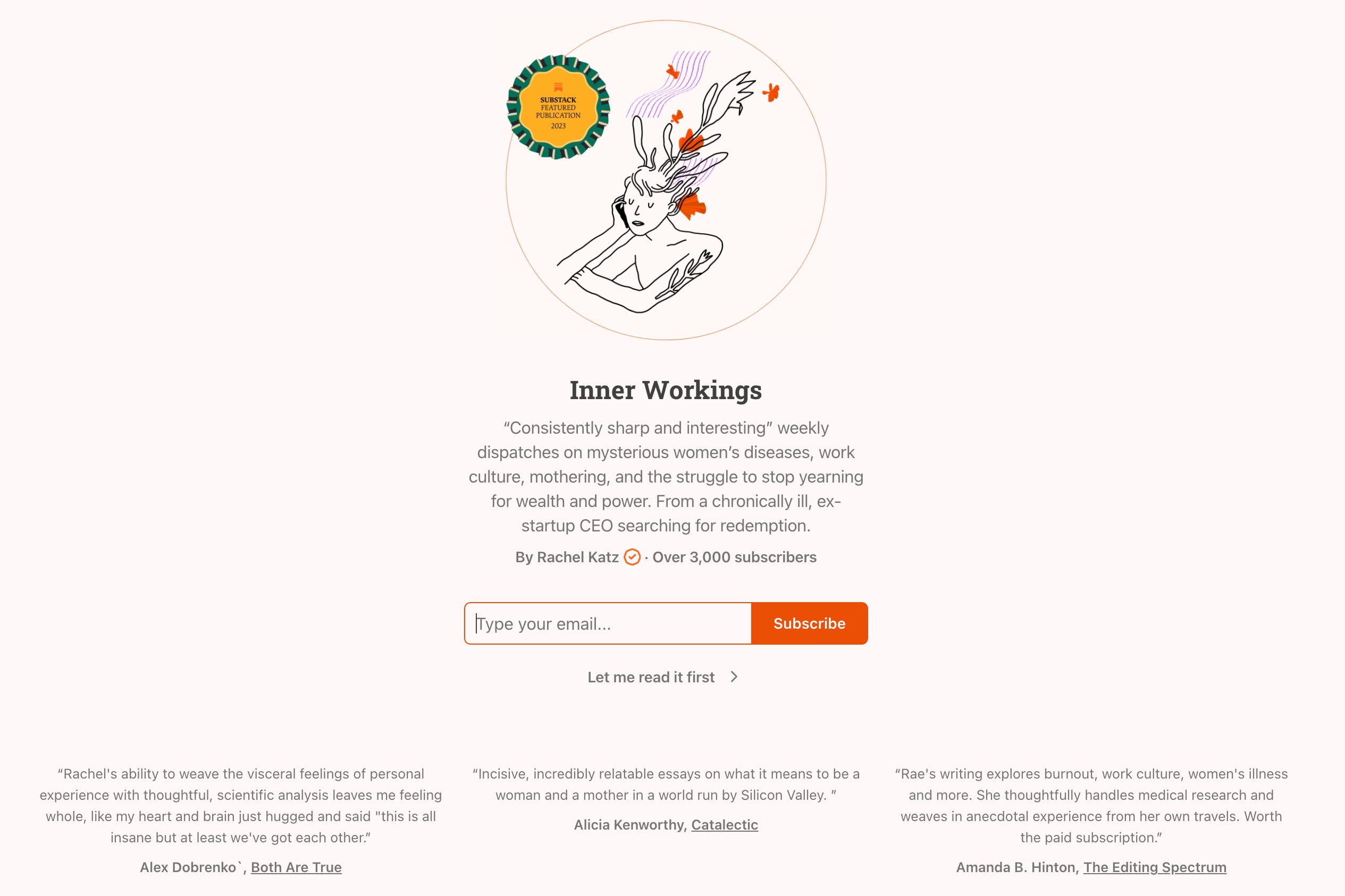
Erin: Right. So after that, maybe they see you on Notes or they see a piece of yours that was shared on Notes. They might click on your name and then go to your actual newsletter. And if they're not signed in or if they've never been to your newsletter before, they are likely going to hit a welcome page, which is that page that has your branding, your newsletter name, and short description. It's a conversion page, basically. A place to subscribe. And then if you're on desktop, there's also space for the blurbs that people give you when they recommend you on the bottom of the screen.
Amanda: I just want to say that I actually use my blurbs as a way to give shout outs to smaller publications. I rotate through them. I don't leave the same ones up there. It's great when I hear from someone with a larger audience, but honestly, people who have smaller publications, they tend to give really heartfelt and meaningful reflections on their experience. And I feel like that means so much to me. And I think it also helps people get an idea of, “Oh, well, if they think that, maybe I'll give it a chance.” So just as a side note, that's something I try to do.
Erin: That's so true. I know that people typically like to use blurbs of really prominent newsletters. It does help, sure. Shout-outs helps us all. But I definitely always think that a really good, powerful description advocating for your newsletter is going to be better than the name that actually wrote it any day of the week.
Amanda: Yeah, I agree. Totally agree.
Erin: Well, maybe what we can do is take a look at a welcome page quickly. Next, we're going to talk about home pages once you get past the welcome page. But welcome pages are a good pit stop. They are something that we kind of have to talk about when we talk about first impressions because this is a conversion page and people might click right through or you could really grab people and get them to convert before they even hit your homepage. So it's an opportunity that is worth thinking about. We're going to talk about Rachel Katz’s welcome page…
Amanda: I didn't know I was on her [welcome page]. Oh, thank you. Yeah. Thank you. Thank you. Heart you!
Erin: Yeah, we've worked a lot on this homepage. Obviously when she got a badge, we added that to her logo here. And we did that just as a piece of recognition to her publication. [Moving down] we have the title [of her newsletter]. And then what I did in my recent editing of this, because Amanda, you put it so well that we'll be just sort of continually tweaking this forever and ever…
I inserted a piece of a testimonial here in quotes (in the description). So that it just says like, oh, I'm being talked about and people have nice things to say about my writing. And that way, if they're seeing this on mobile and we don't have all of these really beautiful, juicy blurbs at the bottom, which disappear on mobile, we get at least like a little snippet of a testimonial, which I like.
And on this page, I usually say, we're looking for: what is this newsletter about, who's it for, and who's writing it. So right away, we have the fact that these are weekly dispatches and then we've got some topics. And then we've got who it's coming from, who Rachel is. And within this, we are painting a picture, even though we're not saying it explicitly of who it's for.
So within these topics, mysterious women's diseases, work, culture, mothering, and the struggle to stop yearning for wealth and power. These are topics, but they're also invitations. They're also saying if you have a mysterious disease and you're a woman, if you are struggling in hustle and work culture, maybe you're a parent, this is all gonna be relevant to you.
[Moving down,] we've got this subscribe button, which is not customizable, but this funny little text underneath the subscribe button weirdly is customizable. And I think that this could be really straightforward. The only thing that I wouldn't recommend doing that I did see recently is someone wrote here, "Let me read for free." And that makes it sound like if you were to enter your email address, you would have to pay. So that's the only thing that we don't wanna do here—we just wanna avoid making it seem like, by entering your email address you have to pay.
Amanda, do you have any thoughts on how this welcome page is working? What it might be missing? Any thoughts on opportunities here?
Amanda: I think her recommendations are splendid, by the way. (Just kidding.)
Erin: Especially this one by Amanda.
Amanda: I think you really touched on everything here. This is maybe a place for me to confess. I like to change the verbiage under here, even though I have no way to track whether "Let me read it first" or "Let me take a peek" or "I wanna see what's going on here" worked better than the other. But I like playing with the verbiage where people have choice and to feel like both options are equally good.
Erin: We're not saying like, oh, you're really missing out. Yeah, and that's a personal choice. You guys can make whatever choice you want, but I do appreciate a softer sell on this page for sure.
Think about first impressions like you’re on a first date
16:10
Amanda: Yeah, I do too. And I think that's something to also think about in these first impressions: “What would you do on a first date that you wouldn't do if you'd been married for 10 years?” Like, how heavy of a sell are you putting out in the beginning? Well, actually … you might not even hug, you might shake hands and you might have more of your manners on display in the beginning. And I think that kind of overlaps here with assuming the best about the person who's landing on your page. These little things, they do add up into a whole first impression.
Erin: I love it, a whole vibe, yeah. Actually, before we move on, I do want to show ... can you see this, the lol/sos welcome page?
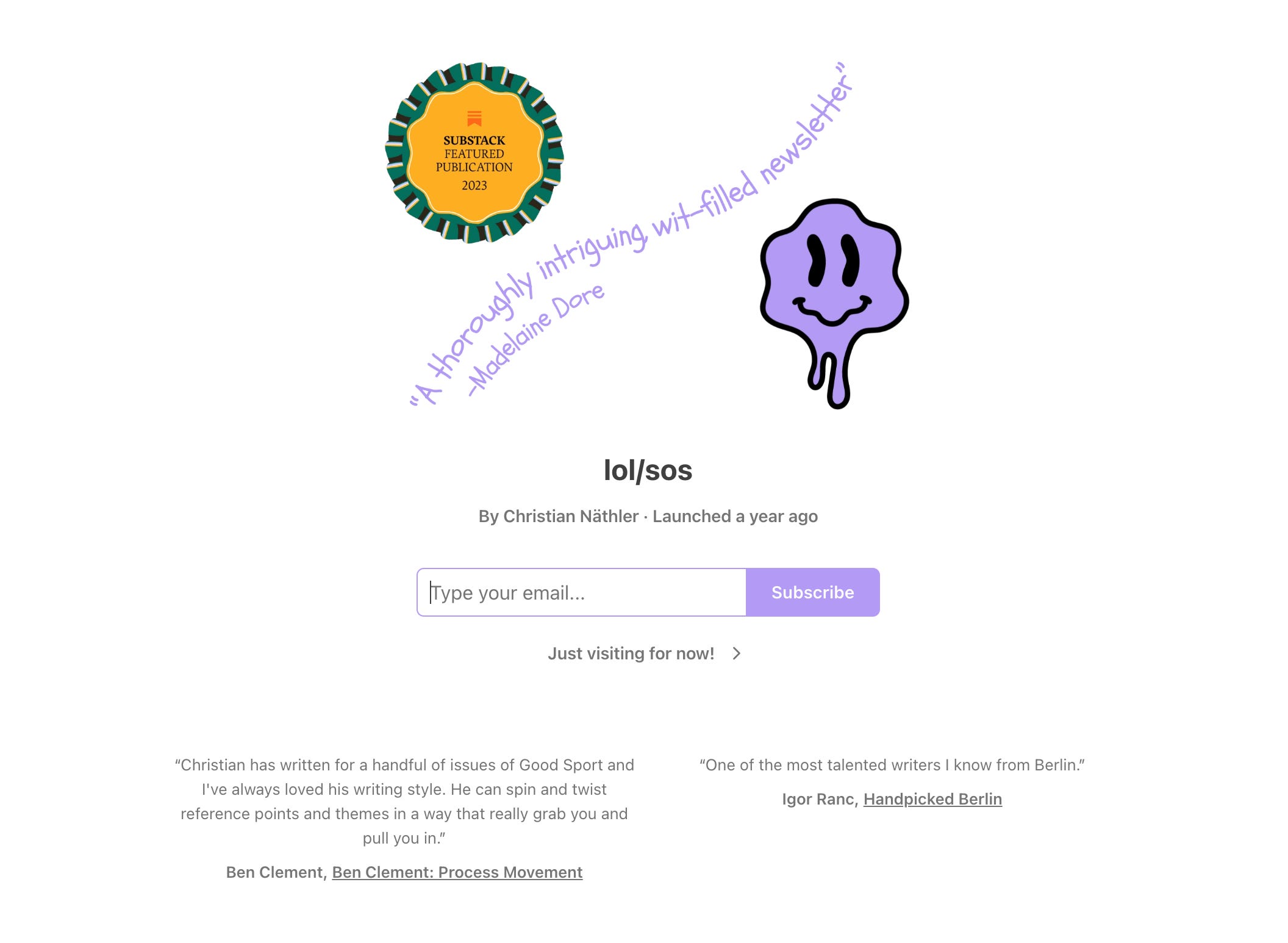
OK, so when Christian Näthler and I were talking about this, we weren't quite sure, I see now that he doesn't have a description on his page, which is totally fine. But I think initially the description was: “A newsletter about nothing the same way Seinfeld is about nothing.” And I loved that because it didn't tick any of the boxes [I just talked about], but it was really charming. And it had some personality. At the time, we weren't sure if we were gonna use blurbs. So if someone finds you on mobile and there are no blurbs, what do we do with that? And so I was like, what if we added a testimonial or blurb right into the design of this graphic here? So we still have his badge and we still have his logo, but then he actually designed it so that this testimonial is going right through, which kind of replaces the newsletter description and lets someone else speak for him instead of him describing the newsletter. So this is just another option that I think is really playful and kind of whimsical and creative.
Amanda: OK, so let's say that they decide to read. Yeah, what do we see next? What's that next first impression?
A home page first impression
18:41
Erin: So this is the heart of first impressions. [A reader] made it to your newsletter, whether they subscribed or didn't subscribe on the welcome page, and they've ended up here. How quickly can they get the lay of the land, the gist of what it is you're writing about, the gist of what it is you're offering?
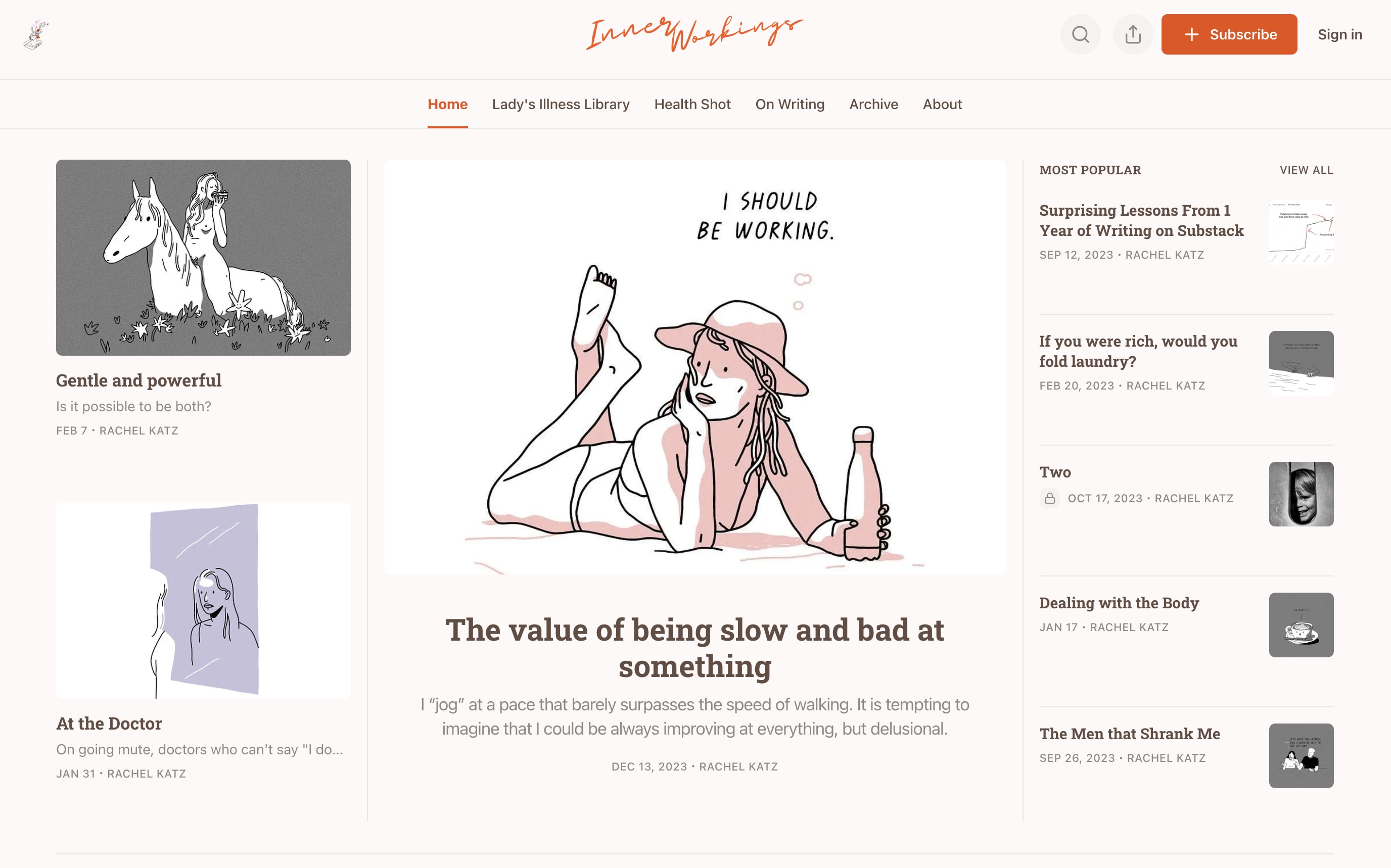
We chose Rachel's [to show] because she really does give a great first impression. And I know that some of our conversation revolved around, what should this first pinned post be? Because if we're on mobile, we get just the first pinned post. And so, yeah, Amanda, maybe you can chime in and talk us through that.
Amanda: Yeah, I feel like there's been a big uptick in hero posts.
Erin: Like the welcome post, “welcome to blah, blah, blah.”
Amanda: Yeah, welcome. Here's, yeah, it's almost a repeat of your “About” page.
Erin: Yes. Right.
Amanda: And you can be as creative as you want to. When we were thinking about these [hero posts]… because I've seen them making their way through our little Substack ecosystem …
Erin: And they’re so hot right now.
Amanda: It is. It is hot to be a hero. And, and I think where I'm at right now is that there's just lots of things that people are going to experiment with. I think there's definitely places where it makes sense to use the hero post so that even if they land on your own mobile scene, that's going to be part of how you make a good first impression. Probably if you're writing a niche newsletter or about controversial things—like if you're talking about politics—how are you qualified to talk about politics? Have you worked on campaigns? Have you done things like that? I think that makes sense for a hero post to basically set the ground for your credentials.
Erin: Yeah, I love that.
Amanda: And so when I was considering one for myself, I thought, well, actually I have so much fresh content coming up. I feel like that's what I want [showcased]. I want it to be a dynamic experience when someone lands that it is a fresh new sort of amalgamation of all of the things that I'm doing in The Editing Spectrum and that I don't want one thing to kind of dominate all of it. So that's kind of my line in the sand. And I feel like with everything, it's a good thing to experiment with.
Erin: Absolutely. Yeah, I think experimenting with it, considering what your newsletter is about, what you most want to be known for, asking yourself these questions will help you decide if a hero / welcome post pinned to your homepage is the best idea for you. Because Rachel is an essayist and a memoirist, she kind of wants her work to stand on its own. And she's not dealing with topics where she needs to be super credentialed. She isn't a doctor, she isn't giving health advice or anything like that. She can kind of skip that for now. [A hero post] is not necessary to the homepage. What I love about her homepage is it still paints a pretty full picture even without that hero post.
So, in her main navigation, you have this Lady’s Illness Library that tells a new reader right off the bat that she's collecting a series of stories or interviews or something that has to do with women's diseases. [Pointing to the Health Shot category in the main navigation] You can tell that she's going to write about health. [Pointing to the On Writing category in the main navigation] She's going to address writing as probably an art, a craft here.
And then all of her images have a really cohesive feel to them. A lot of them are illustrated. And then just her titles alone, like At the Doctor, Forest Medicine, The Value of Being Slow and Bad at Something, they're a bit on the vague side at times—like At the Doctor. But then her subtitles make up for that a little bit and are a little bit more literal and giving more context into what this post is actually about.
I really love that about this homepage, that she mixes some literary elements with literal elements of, this is what this post is literally about. Here's where the work culture comes in, “Confessions of an Entrepreneur,” “Musings from a Weary Former CEO.” So if we breezed right through the welcome page, we're still getting a sense of her as a businesswoman who's interested in health, who's interested in women, and interested in writing. And I think that gives a really full first impression from this homepage.
Amanda: Well, this was fun. I liked looking at that. Rachel was really the first newsletter I found. I can't remember now how I found her, but she was such an inspiration to me to think about writing in a less burnouty way. I think that was really important. And there's actually a huge subculture in Substack asking how do we be writers and honor what we're really able to give in our writing? [I love the idea] that all writing counts—you know, it counts even as you're wayfinding. So I love that.
Erin: Yeah, totally.
Amanda: Well, thanks for nerding out with me. I feel like it's important to talk about these things especially as neurodivergent women who ... part of why we work well together is that we're both really sensitive to doing things with our writing that could feel normalizing.
Erin: Yeah.
Amanda: The world feels very normalizing and that's not what this [conversation] is about at all. I think if we ever met somebody, even a stranger on the street, we'd be quick to say, “No, we trust you and your instincts. We trust you to know what you want to share and how you want to share it.”
Erin: Yeah, which is why I think these conversations are important because it's like, here are some things to consider, but at the end of the day, the best first impression is you being your weird little self. Whatever is really true and authentic to you, ask [yourself how] that's gonna resonate with people. These are just some things to consider along the way, some places that you're inevitably gonna be making a first impression.
Amanda: So recording this today, it's sunshiney outside here in Texas. I think you've got sunshine in Oregon.
Erin: I know, sunshine in Oregon! It's incredible. It's a miracle.
Amanda: I sent it to you! You're welcome! By the time we publish this and you're watching it or reading the transcripts, we'd love to hear from other writers. What's your favorite part of your welcome page or your homepage? I’d love to hear about it because we're always taking in new information. We're always putting a new lens on this especially from the idea that even your welcome mat at your house might change because it's springtime. Like how are you gonna change it? How did these things evolve for you? I think that's a really great thing to crowdsource, to be honest
Erin: Me too. Yeah, I'd love to hear about points of pride. Things that people really love about their first impressions. And if you are confused about anything or curious about our opinions, we'll meet you in the comments.
Amanda: Yeah, we'll be in there. We're chatty. OK, well, thank you so much Erin for jumping in here with me. I'm so glad our dogs cooperated for this recording. Isn't that a nice little miracle?
Erin: Another miracle! It was the candle, I think ...
Amanda: It was. It blowing out was just helping them rest and get into their zen space. Thanks for tuning in and we'll see you in the ecosystem.
Erin: Thanks Amanda. Thanks everyone. Bye!

Tell us in the comments about your first impressions
Have you been thinking about revisiting any of these items we discussed (photo, bio, short description, welcome page, or home pages)? If so, how can we help?
Share a link to your newsletter and tell us what you’re most proud of!
Is there someone on Substack who makes an amazing first impression? Restack this essay, tag them and tell us all why! (Erin and Amanda will be re-stacking and shining a light on your recommendations!)
I had a session with Erin the other day, she's great!
What I like about my homepage for my newsletter is the way that the visuals jump out -- it just looks like a creative, playful place: https://oliviarafferty.substack.com/
What I'm going to be working on next is making my 'About' page more conversational in tone and first-persony. It's a bit tight at the moment. Beyond that, I'm going to be adding some Sections to help clarify the different threads of my newsletter.
Great interview! Thanks Amanda & Erin ✨
I found this so helpful! Nothing seems to escape your razor-sharp minds! It actually took me a while to get through the video because I kept stopping to put your advice into action. Somehow, for instance, I'd overlooked the section on settings where you can change the blurbs for your welcome message. It was great to look at some of those blurb options (I'm lucky enough to have a few) and choose which ones to use (weirdly, though, one can't be removed; it's from a writer no longer on the platform and their name doesn't come up on the list of blurbs).
So thank you, both of you!