

What actually made this Substack post take off
My shortest post in 90 days outperformed everything. The data is helping me understand why.

A warm welcome to everyone who’s joined The Publishing Spectrum this week — especially the sidebar enthusiasts. My editor’s heart is beaming a little.
If you’re new here, introduce yourself in the comments. I’d love to know what you’re working on.
The pattern I almost missed
Last week, a short post about sidebars quietly became one of my top performers.
📊 The Data Inside This Week’s Viral Post
Substack just gave you a sidebar...
168 likes
29 comments
30 restacks
512 words (my shortest post in 90 days)
Published right as Substack rolled out the sidebar feature
Written for a free audience
Note: Data synthesized inside SubSight.
On the surface, that all makes sense.
But there’s one part that really stood out to me:
This post generated nearly 3x the likes of a recent 1,300-word piece — with less than half the words.
And that’s a pattern I am looking at seriously.
Engagement per word was dramatically higher.
If you’re like most Substack creators and trying to understand what actually moves your writing forward, that ratio is far more useful than raw views or even static open rates.
The question that always follows
If you’ve been publishing for any amount of time, you’ve felt this moment:
A piece goes somewhere you didn’t expect. And the question shows up almost immediately:
Why did this work when other pieces didn’t?
It’s a deceptively hard question. It’s almost an unfair question, if I’m being honest.
Because in the moment — when something is resonating — it’s very easy to misread your own instincts. You start telling yourself a story about why it worked, and that story isn’t always accurate.
So instead of only working through my instincts (which I do invite into my creative processes!), I turned to the data.
What the data helped me see about my writing (that I didn’t want to admit)
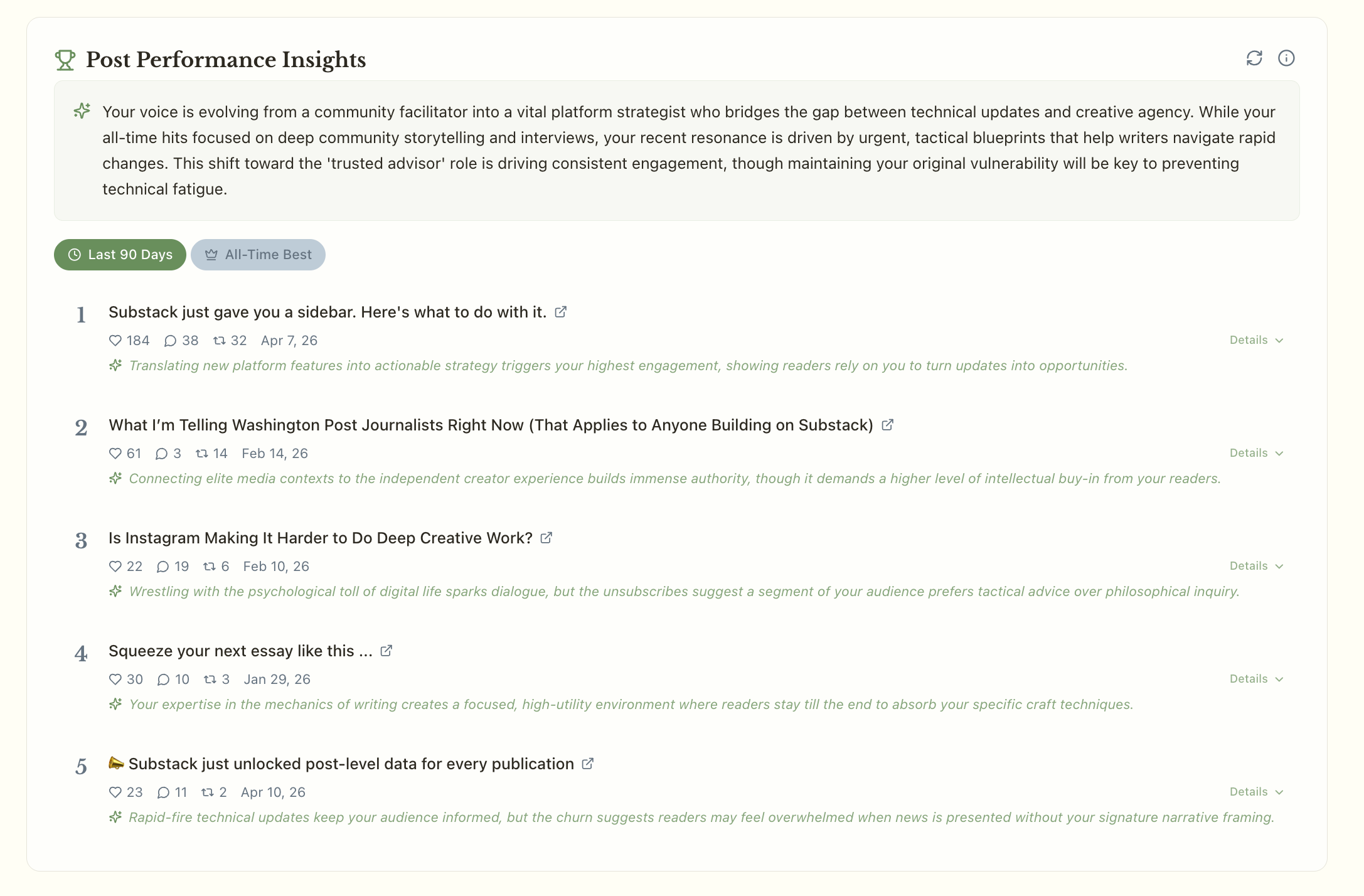
When I ran this through my Top Performers and the Post CSV analysis, one insight surfaced almost immediately:
I’ve been leaning more philosophical than practical lately.
I already know this about myself.
My writing tends to move between two modes:
contemplative, reflective, idea-driven
practical, editorial, grounded in craft and experience
But being in your own writing life makes it hard to see when you’ve drifted too far in one direction.
This is where data becomes incredibly clarifying. Because without it, I might have walked away from this moment thinking:
People really liked that idea.
Instead of the more useful truth:
People responded to a clear takeaway, being concise and how I apply publishing tools.
That’s very different editorial feedback.
A simple way to see this in your own work
You don’t need any special tools to start noticing this pattern.
Try this:
✦ Find Your Resonance Score ✦
Inside Substack:
Settings → Posts → Filter
Sort by Comments
Then look at Free subscriptions driven
You’re not looking for your “most read” posts.
You’re looking for the overlap:
The pieces that made people respond and brought in someone new.
Find 2 – 3 of those.
Then ask:
What do these posts have in common?
How long are they?
How quickly do they get to the point?
What kind of response do they invite?
Most Substack creators never look here, which is often why they keep optimizing for the wrong elements in their writing.
Where this gets difficult (without help)
You can do this analysis manually.
But it gets harder when:
You’re looking across dozens of posts
Patterns are subtle, not obvious
Your own preferences start biasing what you see
That’s the real challenge:
You’re in a relationship with your own writing — so you’re not a neutral observer.
And that’s exactly where I’ve found the most value in using SubSight.
What SubSight is actually doing
SubSight isn’t just looking at your metrics.
It’s synthesizing patterns across your writing so you can see:
What consistently drives engagement
What actually converts readers
Where your editorial drift is happening
In this case, it helped me see something simple but easy to miss:
My audience responds more when I balance insight with application — and keep it as succinct as possible.
That’s the kind of feedback I can use before I publish my next piece.
Before you publish your next post
Most writers look at performance after something works.
But the real advantage comes from seeing your patterns before you hit publish again.
Before you default to your usual length
Before you lean too far into one mode
Before you miss what your audience is actually responding to
If you want a clearer view of what’s working in your own writing, SubSight maps your top patterns across the last 90 days — including your Resonance Score.
Upgrade to start using SubSight to see what’s actually going on inside your Substack publication.
This post was an attention grabber. As an old-school publisher who once wrote coverlines with newsstand sales in mind, I’m not surprised it was a winner. You brought readers good news they might have missed. Your headline deftly suggested they’d be the first to know. In a few pointed paragraphs, you showed us how to apply it. Excited as I am about the potential of SubSight, I’d say this post is a shining example of tried-and-true principles in action.
If all you offered was punchy, purposeful tips from the leading edge of Stackland, you would be someone different. The mix is where (to me) things get interesting. Many readers, perhaps most, will also value your more meditative posts that won’t get measurable results tomorrow but do position you as a trustworthy mentor attuned to the challenges of staying true to your vision on this ever-changing platform. Maybe SubSight can clarify what it takes to nail the mix.
This is fantastic, Amanda!
Someday I'll stop defaulting to 2,000-word posts and then I'll know I'm making progress!