

Stop guessing what your Substack data means
A tool that handles the publishing and growth questions so you can get back to writing.

A few days ago I wrote about the meaning of language and words and the tension I carry every time I open an AI tool.
It often feels like I’m putting on a hazmat suit, the sense that something powerful is sitting in front of me.
And the question I keep asking myself:
How closely should this touch my writing?
I meant every word of that piece.
And at the exact same time, I also know that for the past 18 months, I’ve been watching Substack creators lose something quieter than their craft. They’ve been losing time.
Time spent wondering whether their free list is actually doing anything. Time squinting at a dashboard that tells them how many subscribers they have but not what those subscribers are doing, or why, or what any of it means for the next creative decision they need to make.
I think a lot about the time that could be spent writing or reading slowly.
So, I built a tool. And I need to tell you about it.
***
SubSight is an audience intelligence dashboard for Substack creators.
It takes the same analytical work I’ve done by hand inside one-on-one data audits — across publications with a few hundred subscribers and publications with 200,000+ — and makes it available inside a dashboard built around your own publication.
I think it’s important to be honest about what it is and what it isn’t.
It is not intended to create more noise in your creative and publishing life. It’s not another AI tool telling you what to write or how to think or what your voice should sound like. I’ve been clear about that line, and I’m not crossing it now.
(One beta tester reported back to me that she chuckled when the tool diplomatically told her it wouldn’t write a Susbtack Note for her.)
SubSight exists because across every publication I’ve analyzed, I kept finding the same thing:
The most important publishing decisions creators make are often the ones they’re making in the dark.
Your Substack dashboard can tell you how many subscribers you have and it can show opens and broad growth trends.
But it can’t tell you how free and paid readers actually behave differently, how long it takes someone to upgrade or which parts of your publication are quietly working against subscribers deciding to upgrade.
That’s the gap I saw again and again. And that’s what SubSight is built to address.
***
A look inside the SubSight dashboard
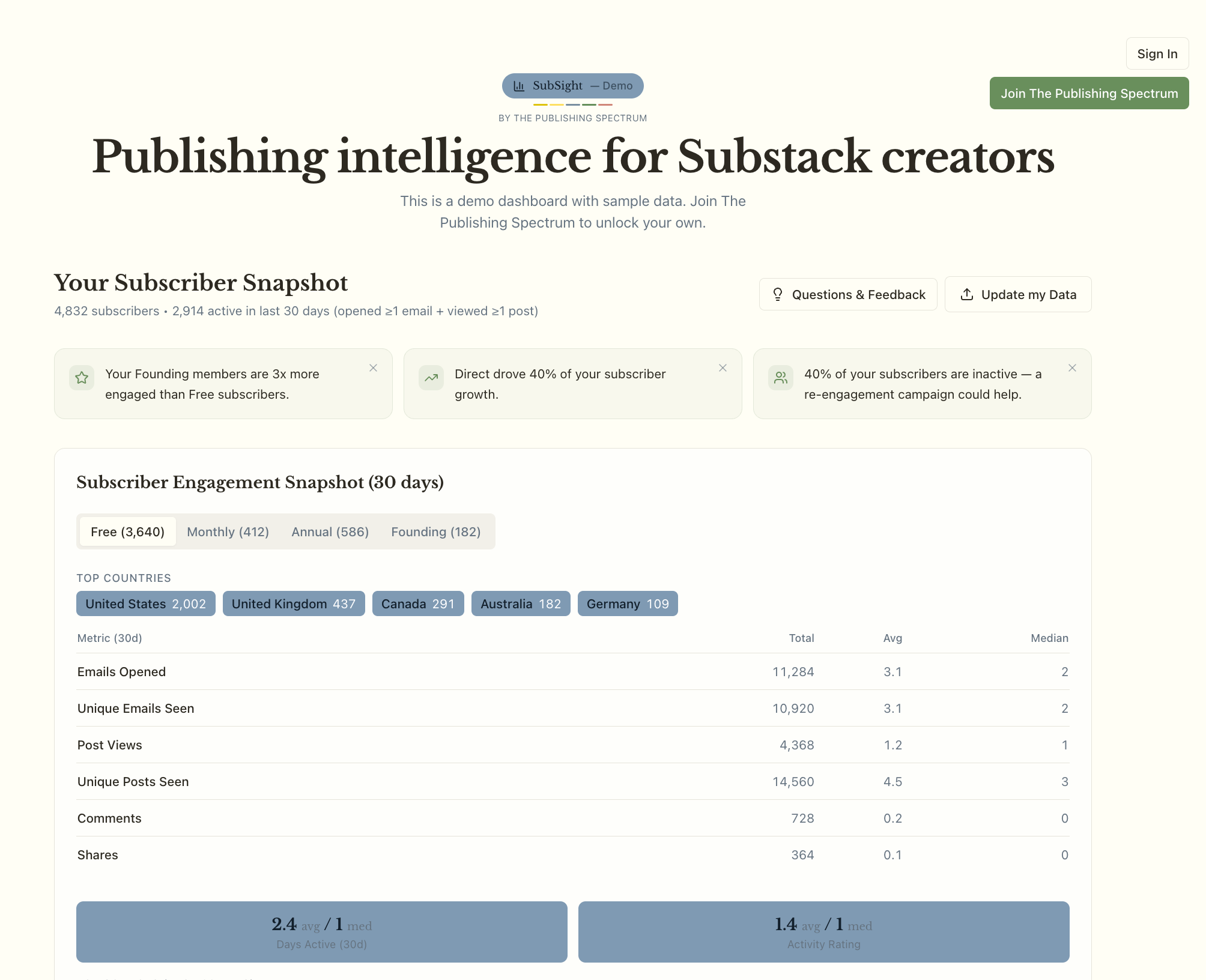
Identify who is actually reading. SubSight reveals how your free, monthly, yearly and founding subscribers behave differently — so you stop treating your most loyal fans like strangers.
→ In private audits, I see a pretty steady trend: paid subscribers consistently show two to four times higher engagement than free readers, regardless of niche or list size.
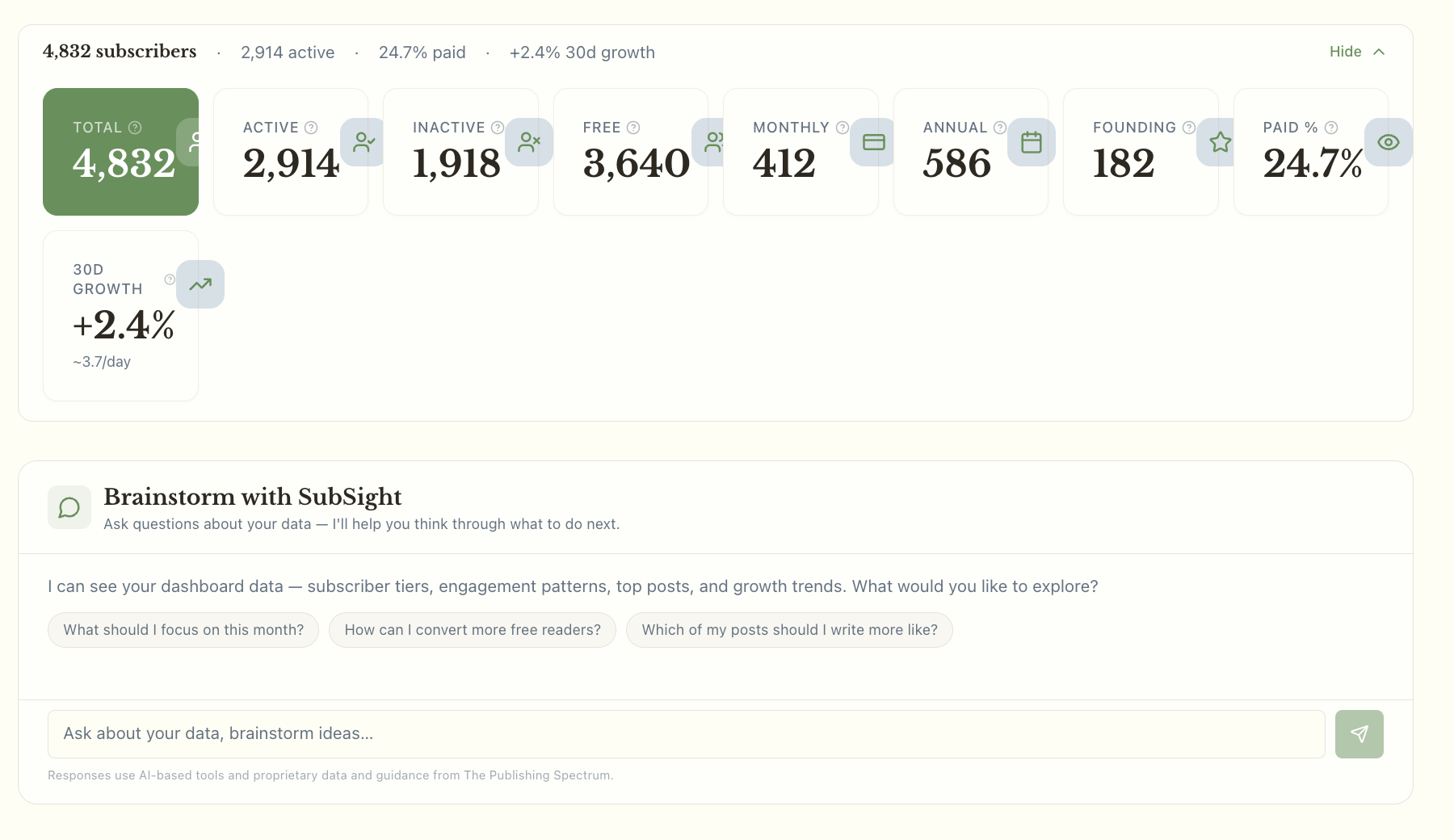
You can see where your subscribers came from and, more importantly, understand how your publication is responding month over month because of the writing you’re sharing with them.
→ One please we’re looking is the relationship between email opens and unique post views, organized by reader segment so we can learn more about how the people gathering around your voice actually behave and respond to that work.
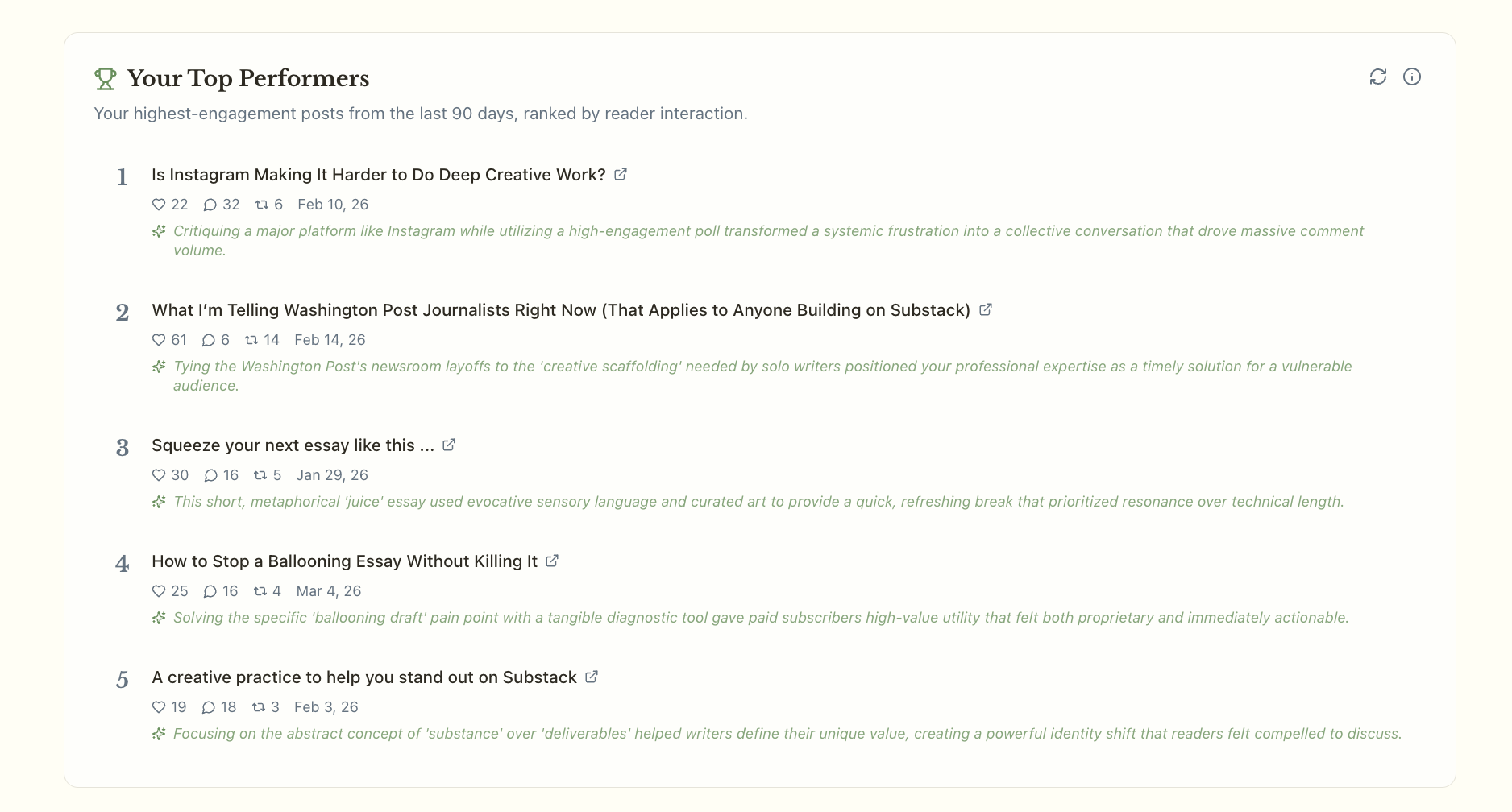
You can see which posts are doing real work — not just getting opened, but increasing engagement, attracting subscribers and supporting your overall publication experience.
→ Throughout the tool I’ve tried to incorporate what I call the “So What?” layer: plain-language interpretation of what the numbers mean and what you might do next, written from my point of view and the work I’ve done in audits and advising work. Because a chart without context is just a distraction.
***
Why this and why now
I’ve watched creators pour energy into “busy” channels while their actual growth engine was idling in a corner they couldn’t see. I’ve seen 25,000-person free lists with the pulse of a graveyard. I’ve seen “About” pages that were quietly suffocating conversion rates before the reader even finished the first paragraph.
For too long, the business of publishing on Substack has meant publishing in the dark or unmitigated spreadsheet stress — hours lost squinting at CSVs, trying to find the story in the rows. It’s a fog that keeps you from the only thing that matters: the writing.
You shouldn’t need to hire me for a custom audit to see the reality about your own publishing work. So I built the tool to share with you.
SubSight doesn’t replace your editorial judgment; it automates the administrative and creates a powerful pattern-tracking space to help you publish your best work. It clears the spreadsheet stress so you can make sharper decisions and get back to the words faster.
The “hazmat” parts of the work? I’ll keep those for one-on-one audits. But the data on how your publication actually works? That’s not dangerous. It’s just the map you’ve been missing.
***
A few things to know
SubSight is in beta. It’s working, it’s useful and people are already inside it discovering things about their publications they couldn’t see before.
SubSight is still evolving, and I want that to be part of the experience. Your feedback shapes what it becomes.
I’ve also built a brainstorming companion into SubSight — trained on my own frameworks, nearly 20 years of editing and the last four years of pattern tracking inside this great Substack publishing experiment.
So you’ll have a brainstorming counterpart inside SubSight when the data raises questions you want to work through.
***
How to See Your Own Data Inside SubSight
SubSight is available as part of a paid subscription to The Publishing Spectrum.
If you’re already a paid subscriber, you already have access.
Paid Subscribers: Start looking at your data here (you’ll sign up using the email you use for your paid subscription to The Publishing Spectrum).
If you’re not yet a paid subscriber, now’s the best time to join. As SubSight adds more sophisticated audits and features, the price will rise — but your rate will never move.
→ For the next 7 days, subscriptions will remain at the current $10/month.
This is early access pricing for a beta product that’s already delivering the kind of audience insight creators usually have to hire me to uncover by hand. Upgrade today and stop guessing what your data is trying to tell you about your Substack publication.
***
I wrote this week that the words are the point. I believe that.
SubSight is the thing that handles everything around the words — so you can get back to them.
Your data has a point of view about your publication. SubSight helps you see it — and then get back to writing.
Hi Amanda, I've been trying to upload my CSV on SubSight, but I can't, are you having a tech problem at the moment?