

Substack has a new tool in beta called Creator Match, and I’ve been playing with it because this is exactly the kind of thing I want the robots (ahem, AI) to make easier for creators.
And based on everything I’ve seen so far, it seems to take a significant portion of the guesswork out of finding creators who might already be a natural fit for cross-publication collaborations. Here’s what it looks like:
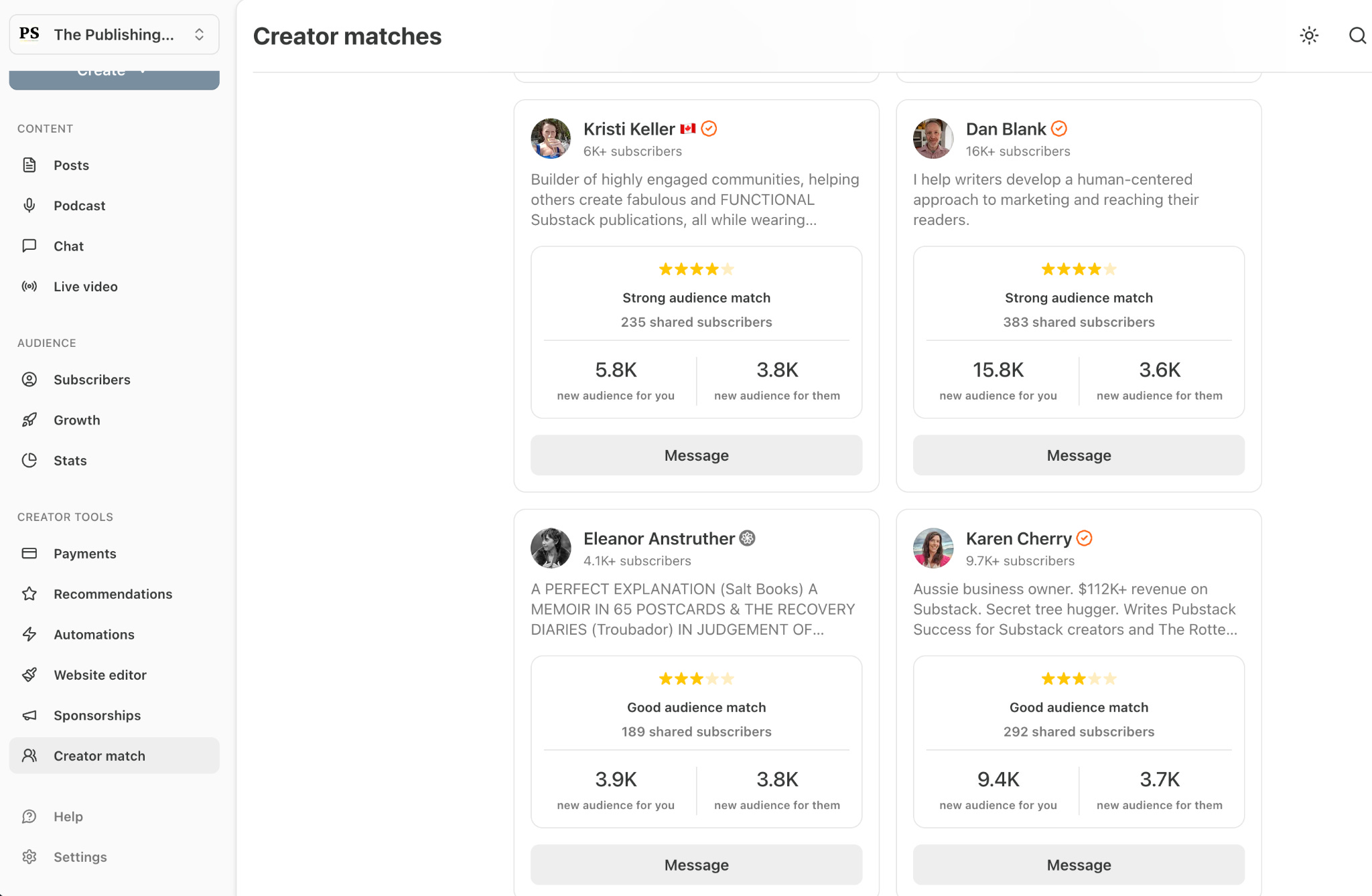
Creator Match surfaces potential collaborators based on things like shared audience and activity on Substack. I’ve started thinking about some of what it’s showing us as platform warmth: Is this person active here? Are their readers already overlapping with yours? Would they be comfortable showing up for something like a Live, a written interview or a conversation inside the platform? That is useful information.
But it only gets us so far.
Creator Match can help you find the person. But your publication data can help you identify the best collaboration fit.
That second part is the piece I’m interested in exploring today.
Before you pitch a collaboration, look for audience momentum
When I’m thinking about a collaboration for a client — or for my own publication — I don’t necessarily want to know which subject has been my biggest winner of all time.
I want to know what is creating audience momentum right now.
So I’ve been looking at roughly the last 90 days of publishing and separating three different inputs:
What subject do my existing readers keep returning to?
What subject is reaching people who did not know me yet?
What am I publishing often that seems to be doing neither?
Those are three very different things.
A subject can be deeply loved by the readers already inside your publication without doing much to introduce you to new ones.
Something else can be bringing new people through the door without becoming the thing your existing audience opens again and again.
And sometimes — this is useful too! — you discover that you’re spending a surprising amount of publishing energy on a subject that isn’t particularly strong at either job. That doesn’t automatically mean you have to stop writing about it. It means you know what job the material is currently doing.
When the goal is collaboration, though, I’m particularly interested in that second category: Where are people who don’t already know you finding their way in?
Because if the purpose of a collaboration is to introduce two audiences to one another, that gives us a much more interesting place to begin.
We tested this concept during today’s paid subscriber live.
One publisher discovered that the material her existing readers were returning to most was connected to historical film and cultural stories. But the subject actually bringing new people into the publication was autism and neurodiversity, which she had been exploring through film.
That is a completely different insight from her data.
Instead of saying, My readers like film, therefore I should collaborate with another film writer, we can ask a better question:
What conversation could she have at the intersection of film, culture and neurodivergent experience — and who might already have an audience interested in that question?
Now we have some material to work with!
The data still doesn’t get to make the decision
I ran the same kind of analysis on my own publication through two different AI tools. Each one gave me a different answer.
ChatGPT suggested I collaborate around changes in Substack discovery and what those changes mean for publishers.
Technically correct. Also: dry as toast.
I will document changes that matter and tools that make things easier for publishers at a publication level. I could probably grow doing writing about discovery ad nauseam. But I do not want to spend an hour talking about discovery mechanics simply because a robot has concluded that discovery mechanics perform well.
Interestingly, Claude’s analysis picked up a more human thread running through my work: the difference between writing and publishing in public.
I saw that and immediately thought, Oh. I can talk about that in my sleep.
That had a spark.
So that is the direction I am currently following.
The difference between these two suggestions is why I think editorial judgment really is the next frontier for Substack publishers writ large. Even on our live paid subscriber call today, I couldn’t help but remind folks that this is why you must be the leading lady of your publication. Because data can surface ideas and opportunities. It cannot tell you whether you actually want to engage them.
Creator Match narrows things down considerably. Your publication data can show you where audience attention is moving. And then your own curiosity has to decide which conversation is actually worth having.
That is the kind of promotion I’m interested in.
Want to run this analysis on your own publication?
Today’s paid subscriber live is about putting these analyses into practice.
Upgrade to watch the full replay and get both versions of the analysis workflow:
the exact prompt series for publishers working from their Substack post-level CSV
a separate prompt series for Substack Bestsellers using the Substack MCP
the full replay, including a live walk-through of the analysis and how I think about the results editorially
The goal is not to let AI or data run your publication.
It’s to use the information already sitting inside your publication to notice where readers are moving — and make a more intentional decision about what you want to do with that attention.


